3 DECEMBER
2026 - BREDA
2026 - BREDA

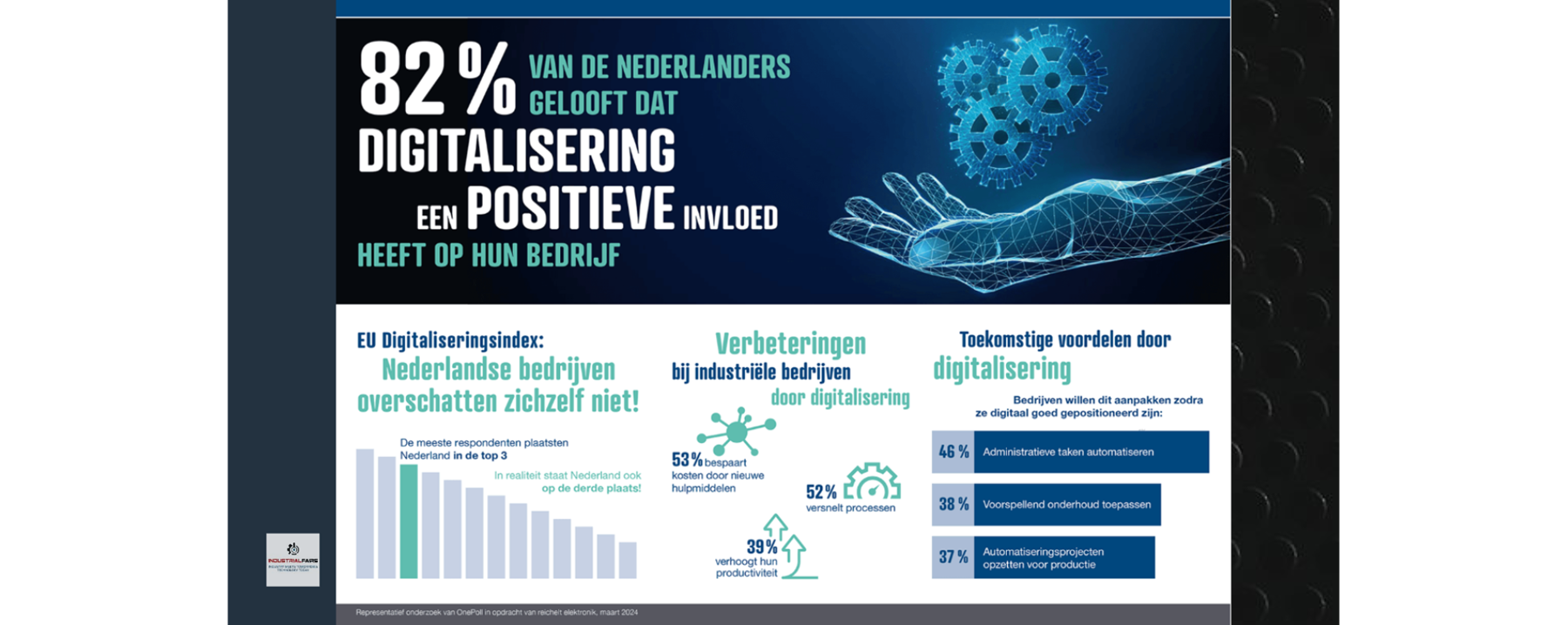
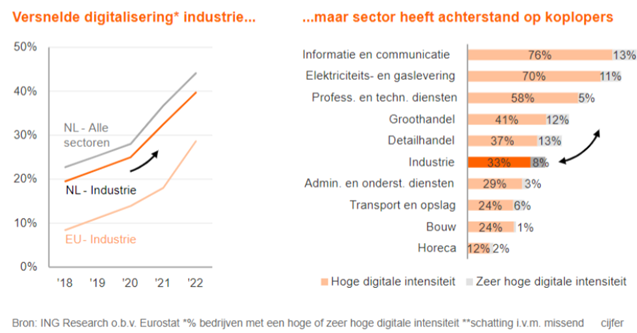
The Netherlands can confidently be considered one of Europe's frontrunners in digitalisation. This is reflected in its strong performance, ranking 3rd on the EU Digitalisation Index. Dutch businesses are convinced that digitalisation contributes to higher productivity, smarter automation of administrative and production processes, and enables applications such as predictive maintenance. Sectors such as Information Technology & Communication (89%) and Energy (81%) are highly digitalised. However, the Dutch manufacturing industry significantly lags behind countries such as Ireland and Sweden, with only 41% of industrial companies being highly digitalised, compared to more than 60% in those countries.
The main challenge lies almost entirely within SMEs rather than large enterprises. Large companies already show relatively high adoption rates for digitalisation (60%), robotics (33%) and cybersecurity (75%). SMEs, on the other hand, perform significantly lower, with adoption rates of only 25% for digitalisation, 12% for robotics and 25% for cybersecurity. Various sources indicate that the Netherlands does not lack the technology or expertise required to accelerate digital transformation. Instead, the main obstacle is that many SMEs remain reluctant to embrace innovation. This highly diverse group of suppliers plays a crucial role within the broader industrial supply chain and is therefore a key factor in strengthening the competitiveness of larger manufacturing companies.
In short, at the request of its Benelux technology partners, Industrialfairs has taken on the mission of accelerating and simplifying the digital transformation of Dutch SMEs, while simultaneously introducing the next big innovations in industrial digitalisation to the country's digital frontrunners. This ambition is already becoming reality, with a first group of 20 technology partners taking the leap into the Dutch market. You can discover them here.
```

Location and service model!
Two factors are crucial to the success of the first edition of ABISS Breda.
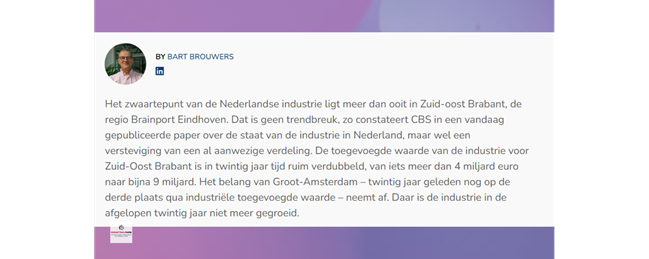
First, the summit must be strategically located to serve the largest possible share of its target visitor market. The Netherlands is home to a vast number of manufacturing companies, including approximately 8,700 machinery companies, of which around 3,000 are active in high-tech machine building, food, pharmaceuticals, and oil & gas. Together, they form part of an estimated 27,000 manufacturing companies operating in or supplying high-tech industries. In consultation with the founding technology partners, and knowing that the heart of Dutch industry is located in the South-East Brabant region, with the country's top 100 manufacturing companies concentrated in the south and east of the Netherlands, Breepark in Breda was selected as the ideal venue. Visitor recruitment is focused on carefully selected decision-makers and is carried out in collaboration with knowledge centres, universities, and a broad network of leading print and digital technology media.
Secondly, an event such as ABISS Breda requires affordable all-in participation packages for exhibitors, combined with a strong focus on hospitality and visitor experience. Easy accessibility via the country's main motorways, ample free parking, complimentary high-quality catering, and modern event facilities were all decisive factors in selecting the venue for this first summit and networking exhibition.